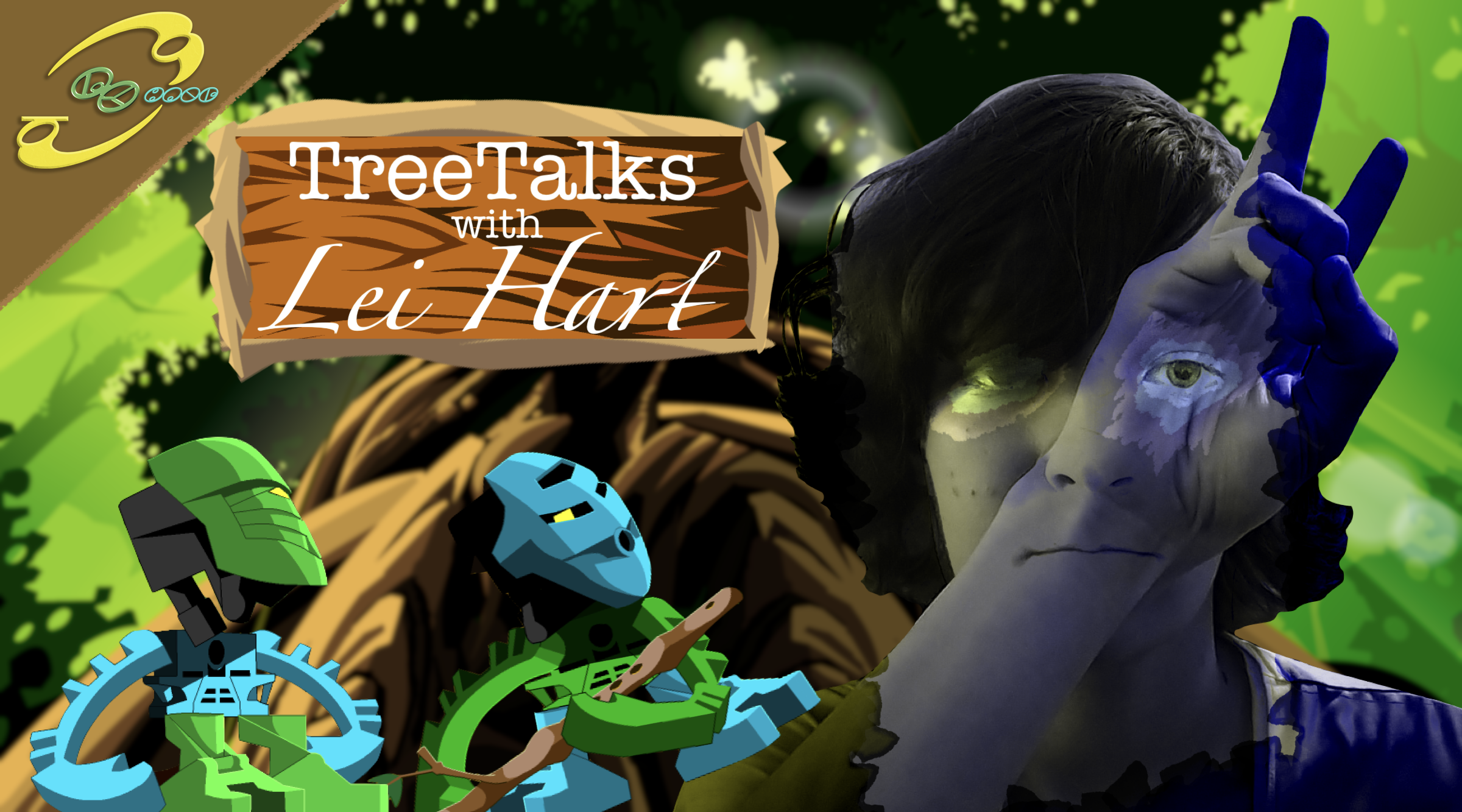
Gathered friends, welcome to yet another post by the Le-Koro Band!
This week, in the middle of band rehearsal, a tear in space opened in front of us, and a figure emerged from the bright white portal. We were graced by a traveler from a far-off land, a chronicler who had been telling the story of robots in an alternate universe to our own, who were struggling with self-discovery, all while wrapped up in a strange mystery. Sound familiar?
The chronicler was none other than Lei Hart! They had collaborated with us in the past by voicing the character “Treyla” in the Ide’s Journey series, and they had written an original song for the character, “I Won’t Settle,” which was released as a single last year:
We talked about the song, the sources of where emotionally resonant music can come from, working in collaboration with various groups, and their experience making art, music, and creating original stories, like with the TechnoSapient Universe of Robotrio!
So, gathered friends, and honored guest…
When were you first introduced to the world of BIONICLE®? What was your first set?
One of my first memories related to Bionicle was in 2007, when my older brother was funnily enough complaining about how uncool Jaller Inika was compared to the Optimus Prime toy he had, waving around the Jaller figure to emphasize his point about its profound uncoolness. Fast forward a year, and all my siblings are total Bionicle-heads, myself included. I was 6, so I wasn’t remotely interested in the lore, just in playing the online Phantoka Battle for Power games, which I continued to navigate to until LEGO took down the page—fun fact, the loop versions of Gravity Hurts from those games are more nostalgic to me than the song itself!
I never got into the lore until G2 got announced, and even then, I was almost exclusively zeroing in on the G2 lore over G1. I had played with Bionicle figures before and bought figures for my siblings, but Skull Basher was the first one that I had ever bought for myself. I don’t have any particular emotional attachment to Basher, the purchase was just on a whim after I realized I’d never gotten a Bionicle figure for myself before.
How did you eventually find your way over to joining the modern community, 810NICLE Day, and The Le-Koro Band?
I took my first steps into the Bionicle community via BioTube, where I made Bionicle AMVs (or BMVs) in Windows Live Movie Maker. I also joined multiple Bionicle communities on Google+, such as the Rega Nui roleplay community and I think one that was just called “Bionicle.” All of this was in early 2015.
By the time I first heard of Bionicle Day, I think it was either 2019 or 2020. By this point I was more fully integrated in the community, primarily to Vahkiti as the singular G2 fan out there. He reached out to me asking if I was interested in participating in an interview with Ryder Windham, which I eagerly accepted.
Regarding the LKB, I’m not as sure when I joined. I know it was in 2022, but a great deal of things happened that year (I moved out for the first time, I got married, and I graduated community college), so everything from that year is a blur. However, I do remember coming up with the name of Treyla, the character I play in Ide’s Journey. In case you’re curious, it doesn’t mean anything in Aikuru’s Matoric, I just thought it sounded cool.
Where did your musical skills come from? How did you learn and develop them, and when did you begin making music yourself?
I’ve been making music since 2014, when I sat down at my family’s piano and improvised a basic melody over some even more basic chords. At around that time I started learning LMMS, a free DAW that helped me learn the fundamentals of working in music creating/sequencing software. In 2017 I was gifted FL Studio for Christmas, and I’ve been using that as my main DAW ever since.
Who are some of your musical influences?
I’m not sure which influence is heard the most in my music, but if I could narrow it down to a specific artist, I think Cryoshell has affected the way I want my songs to sound the most. Currently, my artist fixation has been Fall Out Boy, and I aspire to their level of lyric writing. But if we’re talking about more general genres, I feel like I have a bit of Bubblegum Dance in my genes as a biproduct of being born and raised in the 2000s.
You mention in your bio that you’ve been studying music technology. Congratulations on nearing its conclusion! What has been the most rewarding and useful nugget of wisdom that you keep coming back to? What is the least useful? That is to say, what’s something interesting you’ve never used, but sticks with you regardless?
Thank you, I actually graduated this past semester! In 2021, after literal years of classical music literature and composition courses, what was genuinely the most useful for structuring my songs was when I started playing Wii Musicof all things. Learning the theory via my courses was helpful, of course—I can’t get enough of Roman Numeral chord analysis, and I unironically think the Nashville Number System should be adopted nationwide—but all I needed to see my pop-oriented songs the way a pop artist does was split the piece into six segments: Drums, Accents (like percussion or instrument stabs, for instance), Bass, Chords, Harmony, and Melody.
University was profoundly more helpful than community college or Wii Music, though, since it had dedicated courses on composing pop music among other music technology nonsense. The most practical thing I learned was how to properly wrap cables, which I now do for any cable I come across (and which I have to be good at for my job). A helpful document that I read in one of my classes was called something like “The Mixer’s Cheat Sheet.” It was a multi-page PDF that included a step-by-step guide on mixing, dos-and-don’ts, where to pan drums and parts in general, things like that. I used it maybe once or twice, and I could hear a difference, but unless I’m working on a music commission, I usually don’t go out of my way to salvage it from my infinite other school printouts.
What does your music-writing process look like? For specific benchmarks, what is your first step, the most difficult challenge for you to overcome, and how do you know when a song is done?
I have two different methods: The more common one is music-forward, whereas the other, more recent technique is words-forward. In both of them, I compose a quick blurb and see how it sounds. That’s the first and easiest step, and like I said earlier, musical blurbs come to me much more easily than lyrics, which are the most difficult part by far. They’ve only become easier since I’ve tried to practice more often. Once I’m finished writing the lyrics and have a melody in mind, it’s then just a matter of finishing segments like verses, chorus, bridge, etc.
You’ve collaborated with the Le-Koro Band on many songs in the recent past, including “I Won’t Settle,” and “Solace,” both two fantastic songs from “Ide’s Journey: Act 2 Disc 2,” in addition to publishing your own music both for yourself and for commissions. How does one develop the skill for writing songs back-to-back without having them sound too similar to one another?
That’s not something I’ve really concerned myself with, unless I’m worried that I’m subconsciously plagiarizing someone else’s song (which has happened before—here’s the most egregious example, which is at the point where it’s effectively just a cover of Alec Benjamin’s Let Me Down Slowly!). I usually have a pretty clear idea of the sort of sound I want for a given sound, and if it ends up sounding too similar to something else, I tweak it by changing the tempo or key or rhythms until it’s different enough that the hypothetical legal teams won’t come after me for it.
Your collaboration with the Le-Koro Band yielded the original character of “Treyla” and her story. But that wasn’t your most notable foray into working on an audio-drama. You also took charge in directing, writing the story, composing music, and acting in your own original audio-drama “Robotrio” that you’ve been making since 2021. How did Robotrio come about?
Technically, I’ve been making Robotrio since May of 2020—one could even argue since 2018, if its cancelled predecessor counts. Before Robotrio, I was planning to do the art for a children’s book series called Pirobots, which was about a bunch of pirate (actually merchant) robots in an airship demonstrating basic knowledge of things like navigation, economics, and other helpful skills. When that plan fell through, I revamped some of the Pirobot designs (from “Blitzoid” and “Sparx” into what is now Castilles and Dant) to make them my own OCs. One day, I drew the two redesigns next to my other robot OC, Ace McNacho (who at the time was an Atomic Robo fan-character), and once I saw the three of them together, I felt like they had a story to tell. And so, they did!
With both Ide’s Journey and Robotrio, what have you found is the most difficult part of writing an original story? What’s the easiest? The most rewarding?
I can’t say much on Ide’s Journey as a whole, but as far as Treyla’s character is concerned, I really wanted to make her a believable character by diving into the underlying anxieties and pressures that would exist for her as a chronicler, such as feeling like a background character in her own life. That’s what “I Won’t Settle” is about more than anything else—a proclamation that Treyla “won’t settle” for recording everyone’s legends except her own. Seeing her bold descent play out in the actual story has been quite rewarding, and I hope believable for the audience!
In Robotrio, or any story taking place within the TechnoSapient Universe, you really have to start from the ground up, which I can see being stressful but is honestly something I find profoundly freeing. Much like G2, I see the TSU as a sandbox where I can make up pretty much anything, provided it doesn’t contradict what’s already set in stone.
The most difficult part of writing a story is setting the broad strokes of a character-driven plot, especially with characters I haven’t gotten to know. It’s easy to play out how they’d react in basic, short-term scenarios, but for a long-form plotline it becomes a lot more daunting to keep the characters’ personalities, motivations, and external factors consistent without leaning into one side or the other.
We haven’t touched on your beautiful art yet! Notably, you also did much of the art of Robotrio! How did your artistic skills develop? Who inspired you? And what is your preferred medium of making art pieces?
I’m giving credit to G2 again for this one! Specifically, the 2015 animations have had a profound impact on my art style, and from 2015 to 2018, emulating that style was almost all I’d ever draw digitally. That’s partially what prompted me to produce the Winds of Change full-cast illustrated audiobook. I think that if I hadn’t created that, I wouldn’t have created Robotrio, let alone in its format as an illustrated audio drama. I work digitally when I’m at home, but when I’m on trips or at work I switch to my sketchbook. If I’m drawing purely for my own enjoyment, I typically go for traditional sketches, whereas project-oriented stuff or commissions are typically digital, but there isn’t a huge difference in preference. One thing for certain though, is that I prefer drawing robots and bonks over humans. Bionicle ruined my idea of normal human proportions, just a little.

Not many members of the community might know that you’re partners with Lehari, another prominent member of the community. Did you two meet through the BIONICLE® community, or did that shared interest come later?
We did indeed! We first met when I joined Red Star Games back in 2017, though we only started dating in 2021. One of our projects together was Heroes of the Stars, a rules-lite G2 TTRPG that I hold very close to my heart. I’m excited to be running a one-shot in that system for 810NICLE Day, so stay tuned for that!
Art, music, writing…what other talents do you have that you’ve fostered?
Oh geez, voice acting, directing, sound design, video editing, language learning… I’ve even dabbled in romhacking games. Pretty much anything that I find interesting, I’ll find a way to learn about how to do it.
You’ve been so prolific with your artistic gifts over the span of your life! How would you encourage someone to be as artistically productive and engaged with collaboration as you’ve been?
One of the statements that has changed my life was a tumblr post that just goes, “You can do whatever you want forever,” and it really is true. I know saying that “the only thing holding you back is yourself” is cliche, but genuinely, if the only thing stopping you from doing a thing is the fear that you’ll suck at it, then that’s a self-fulfilling prophecy. Learning is sucking at a thing until you suck at it less. The other big thing is that when you’re networking or asking people to help you with something, the same thing applies. If you’re too scared, they’ll say no to reach out, you’re not giving them the opportunity to say yes!
As one last piece of advice, specifically for someone working on a passion project with other hobbyists: while I don’t believe that “the worst they can say is no,” what I do believe is that “the worst they can say is words.” When you’re networking online, whether you’re asking for help or offering it, at the end of the day, people are communicating their ideas in an environment that you can always step away from. If the person you’re collaborating with says something upsetting, you always have the option to put your device to sleep and ground yourself in your surroundings to remind yourself that ultimately, this is something you’re doing for fun and for others to enjoy. That doesn’t mean you have to enjoy the process every step of the way, but if one collaborator constantly vexes you or you feel yourself getting abnormally upset, even if you can’t pin down a reason, that’s something you should talk through and be transparent about, even if you’re just talking to yourself.
What are some of your other interests/projects that you’re most proud of?
I’ve been planning another story within the TechnoSapient Universe, though for now it’s on the backburner while I prioritize finishing Robotrio. Aside from that, I’ve been having fun conceptualizing a variety of TechnoSapient AUs, along with crossovers with a friend of mine (who is likely reading this interview!). The majority of them are simply fun thought experiments, but we did produce a scene from one of our crossover stories that I’m incredibly proud of. (https://www.youtube.com/watch?v=sxAJlPVch3A)
I also just wanted to elaborate a bit on my personal attachment to “I Won’t Settle,” and how it resonates outside the context of Ide’s Journey. As you could probably gather from the first question, I have a lot of siblings (5, to be exact), and growing up in said family, it was difficult for me to understand myself outside the context of being “the one in the family who does X,” and I wanted to be judged on my own merit. This song listed a lot of my grievances with that, and it felt unapologetic in a way that was very satisfying.
Five siblings! That makes total sense. More philosophically, do you think music drawn from real-life, firsthand experiences has more weight to it, in song tone, lyric, or story that is more recognizable to a listener? Did you learn anything in your studies about writing music from experience?
That’s a great question, and I absolutely agree with that statement. In fact, 2 Love (my EP, released in April) was partially an experiment to see what would happen when I genuinely wrote about my own experiences. Before that point, all of my songs with lyrics were either painfully generic or…high-concept, we’ll call them. For instance, before 2 Love, I produced a 2021 album called BoneEater, which was all about spooky, cartoonish and gruesome short stories in the form of songs. I removed the album from the Internet because I felt I could do better, but I may re-release it for the sake of posterity (and because some of them still get stuck in my head). But back to 2 Love—while the lyric writing was still difficult, reaching into my own emotions definitely made the words come more easily to me, and it resulted in the best rhyming I’ve released (still proud of “negating all my scarrin’ / cause I’m waiting for the carnivore to stop” in Freezer!).
Did you find that you could finish the songs faster because you felt so familiar with the source material?
I think it’s more that I had a clear idea of the story I wanted to tell. In BoneEater, for instance, I wrote the lyrics to “Apology From A Killer Robot” in maybe 48 hours.
Familiarity definitely helps, and if “genre savviness” counts under the umbrella of knowing source material then I absolutely agree. With that said, the issue with writing about mental health issues and personal grievances (like in 2 Love) is that it can be difficult to access those emotions when they’ve been locked away for so long. Honestly the most difficult part of producing the album was allowing myself to feel enough to actually recognize the emotion that I was trying to process through the songs.
Very true. I hope the process was a healing one for you. I know it’s said that we put a piece of ourselves in all the art we create. Whereas BoneEater had such an accessible idea and story, because 2 Love was drawn from such real, deep-rooted feelings, were you at all worried about putting so much of yourself out there in the EP?
2 Love definitely helped me process things, and creating it honestly encouraged me to be a more genuine person overall. I have nothing to hide about myself, and while I have a long way to go I’m trying to care less about other people’s perceptions of me, and just focus on being unapologetically me.
Aye, that’s the way to live. Thank you for the interview, and for all the additions you’ve made to the BIONICLE®community, and beyond! Do you think you’d collaborate with the Le-Koro Band again? Bring them into one of your own projects?
Thank you, I’ve likewise had a lot of fun answering these! I really like the series of covers that LKB has been putting out, and I’d love to collaborate on some other Bionicle cover ideas I’ve had (such as Gravity Hurts or Come To My Heaven).
Thanks again sharing your creativity with us! What’s next for you, individually?
Honestly, my top priority once my other 810NICLE Day projects wrap up is finishing Robotrio. I’ve been working at it for quite a while at this point, and while I don’t want to see Robotrio as a chore, I’ll definitely be glad to see it in a finished state, both for my sake and everyone else’s. It also frees up my plate for more ambitious musical endeavors, such as producing a full album.
Best of luck with finishing the story! We’re excitedly looking forward to it all!
If you’d like to follow the chronicles of Lei’s adventures, check out the Robotrio website (https://robotrio.github.io/index.html), send them a donation for their hard work (https://ko-fi.com/lei_hart/), check out their YouTube channel (https://www.youtube.com/@LeiHart/), and follow them on their BlueSky (https://bsky.app/profile/leihart.bsky.social).
Until next time: be the best version of yourselves you can be! Don’t settle for anything less!
If you’d like to join the band, follow the linktree below (https://linktr.ee/lekoroband), and feel free to reach out to chat in the comments, or wherever you find us!
Tune in next time for another single release and the next episode of “Tree Talks!”
–Sanso
0 Comments